Danish car owners need to pay an average of $6,926 per year to own a car, an amount that is nearly enough to cover three years of car usage costs in Argentina.
When you turn your attention to emerging markets like Cambodia, a brand-new Toyota Yaris Cross starts at $37,500, while the presence of a large number of second-hand imported cars provides buyers with more choices.

01 Global Comparison of Car Ownership Costs
According to a survey by Compare the Market covering 26 countries and regions, there are significant global differences in the cost of car ownership. Nordic countries generally have high costs, while South America offers the most economical environment for car ownership.
Denmark tops the list with an annual average car ownership cost of $6,926, primarily due to its high depreciation rate ($1,809) and the world’s highest fuel expenditure ($2,892).
Following closely are Germany and Finland, with annual average costs of $6,910 and $6,787 respectively.
In contrast, Argentina, Colombia, and Chile are the three countries with the lowest car ownership costs. In Argentina, car owners pay an average of only $2,407 per year, which is less than one-third of Denmark’s cost. This is mainly due to its low depreciation ($400) and low fuel expenditure ($656).
Colombia’s car ownership cost is $2,968, and Chile’s is $4,927.
Another study analyzed the cost as a proportion of income, revealing that Australia is the most “affordable” country for car ownership, where car costs account for only 49.48% of the average annual salary. The United States ranks second at 54.87%.
The situation in Turkey is completely different, where people need 652.29% of their annual income to own and use a car, making Turkey the most expensive country in the world for car ownership.
Annual Average Car Ownership Cost Comparison for Selected Countries/Regions Globally
| Country/Region | Annual Avg. Ownership Cost (USD) | Cost as % of Income | Fuel Price (USD/liter) |
| Denmark | 6926 | 60.34% | 2.07 |
| Germany | 6910 | 78.44% | Just over $1 |
| Finland | 6787 | 91.58% | 2.06 |
| United States | Not Specified | 54.87% | Just over $1 |
| Australia | Not Specified | 49.48% | Just over $1 |
| Argentina | 2407 | 515.77% | Not Specified |
| Colombia | 2968 | 508.93% | 0.50 |
| Chile | 4927 | Not Specified | Not Specified |
| Turkey | Not Specified | 652.29% | Not Specified |
02 Comprehensive Analysis of Cost Components
The differences in global car ownership costs result from a combination of multiple factors. The variation in fuel prices is particularly striking: Norway tops the list at $2.16 per liter, while Colombia is only $0.50.
Fuel cost is just the tip of the iceberg. Annual vehicle depreciation varies enormously between countries, reaching $1,809 in Denmark but only $400 in Argentina. Insurance premiums also show significant differences, averaging $720 per year in Finland compared to just $248 in Colombia.
Taxes and registration fees represent another considerable expense, at $236 in Germany and $351 in Finland, whereas in Chile, the license plate fee costs only $1.
Maintenance costs cannot be ignored either. Finland requires an average of $2,143 per year for vehicle maintenance, while the inspection fee in Argentina is merely $21.
Furthermore, daily expenses such as parking fees, tolls, and cleaning fees also vary greatly from country to country. These factors collectively determine the final cost of car ownership.
03 The Long-Term Economic Equation: Electric vs. Fuel-Powered Vehicles
The comparison of the Total Cost of Ownership (TCO) between electric vehicles (EVs) and internal combustion engine (ICE) vehicles presents a complex picture. A study covering the United States, Europe, and Asia found that for medium and small-sized cars, EVs generally hold an economic advantage in most scenarios.
In Europe and Asia, the TCO for EVs is typically lower than for ICE vehicles, primarily due to government subsidies, higher residual values, and lower operating costs. However, in the United States, due to lower gasoline prices and limited subsidies, the economic advantage of EVs is less pronounced than in other regions.
The situation is different for luxury cars. Since the purchase price of an EV is almost double that of a comparable ICE vehicle, even considering fuel cost differences, the TCO for an EV can be higher for high-mileage drivers.
The availability of charging infrastructure also significantly impacts the user experience and cost of EVs. China has excellent public charging infrastructure with over 1 million charging points, while Japan and South Korea have 40,000 and 30,000 respectively.
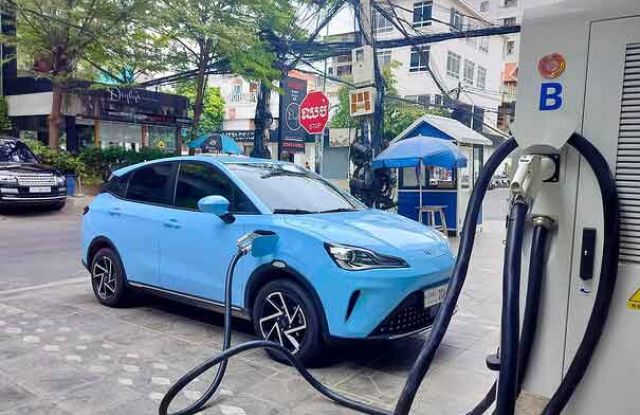
On the streets of Phnom Penh, brand-new electric SUVs and traditional fuel-powered vehicles run side-by-side in congested traffic. The young middle class is changing the landscape of Cambodia’s car market, seeking both economic practicality and a desire for comfort and social recognition.
The Toyota Yaris Cross holds its place in the Cambodian market with a starting price of $37,500. Simultaneously, plug-in hybrid models from Chinese brands are rapidly gaining market share with their “fuel-electric price parity” strategy.
Looking globally, the world map of car ownership costs is rich and varied, from the high costs in Denmark to the affordability in Argentina, and the emerging opportunities in Cambodia. As electric vehicle technology advances, the challenges of winter charging are gradually being alleviated by scientific methods, and global car consumption patterns are quietly transforming.
Looking for top-quality new or used cars? Trust DG Motors for fast, reliable service—or visit our Phnom Penh showroom today!