You’re driving on the highway when suddenly a red warning light pops up on your dashboard—the oil pressure warning. An urgent question arises in your mind: Can I keep driving?
You are not the first person to encounter this situation. Every day, thousands of drivers around the world face the same dilemma. Low engine oil is one of the most common car problems, but most people know very little about how dangerous it can be or how to handle it properly. In fact, data from the China Automotive Engineering Research Institute in 2026 shows that insufficient lubrication accounts for approximately 22% of engine failures—a figure higher than many would imagine.
This article will provide you with an authoritative guide covering the dangers of low engine oil, diagnostic methods, emergency handling steps, and long-term prevention strategies to help you make the right decision.
I. How Dangerous Is Low Engine Oil, Really?
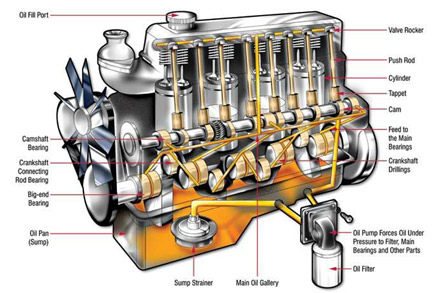
Engine oil is not only responsible for lubrication but also undertakes multiple vital missions such as cleaning, cooling, sealing, and rust prevention.
1.1 Lubrication Failure: Direct Metal-to-Metal Collision
Under normal conditions, engine oil forms a thin oil film between metal engine components, keeping the parts separated. When oil is insufficient, this oil film may rupture, causing metal parts to come into direct contact. Friction increases sharply, temperature rises rapidly, and wear multiplies exponentially. Over time, at best, this leads to increased engine noise and reduced power; at worst, it directly results in complete engine failure.
1.2 Engine Overheating
The operating temperature of the combustion chamber reaches around 2000°C. Although the coolant handles the primary heat dissipation, engine oil carries away approximately 30% of the heat, especially from areas like the piston crown and valves, which are difficult for coolant to reach. When oil is insufficient, the heat dissipation capacity diminishes significantly, causing the engine temperature to climb rapidly. In severe cases, it can even melt components.
1.3 The Worst Outcome: Cylinder Scoring and Bearing Seizure
If you continue driving with insufficient oil, the engine may suffer two catastrophic failures: cylinder scoring and bearing seizure. Cylinder scoring refers to abnormal wear on the inner walls of the cylinders, often costing several thousand yuan to repair. Bearing seizure—when the crankshaft bearing or connecting rod bearing locks up—is even more severe. The engine may require a major overhaul, typically costing between 5,000 and 10,000 yuan.
II. Early Warning Signs of Low Engine Oil
Most car owners only realize there is a problem when the warning light comes on. By learning to recognize the following signals, you can detect issues earlier:
2.1 Abnormally Increased Engine Noise
This is the most obvious sign. When oil is insufficient, friction between metal parts inside the engine increases, causing noticeably louder noise. You may hear a dull rubbing sound or sharp metallic knocking. If you hear an unusual “clattering” sound when starting the engine, you should be even more alert.
2.2 Increased Engine Vibration
When oil is severely low, the engine may exhibit pronounced shaking, and vibrations can be felt through the steering wheel and seat. As the oil condition deteriorates, the oil film cannot support the clearances between components, intensifying metal-to-metal friction and amplifying the vibrations.
2.3 Decreased Power and Increased Fuel Consumption
Low oil pressure can cause the engine’s variable valve timing solenoid valve to operate abnormally, directly affecting the engine’s performance. You will feel sluggish acceleration, delayed throttle response, and noticeably higher fuel consumption.
2.4 Abnormal Exhaust Color
Observing the exhaust is another effective diagnostic method. If the exhaust appears blue, it is highly likely that engine oil is entering the combustion chamber and being burned, which is also a sign of abnormal oil consumption.
III. How Far Can You Drive After the Warning Light Comes On?
This is the question that concerns every driver facing low engine oil. The answer depends on the type of warning light.
3.1 Three Types of Warning Lights, Three Response Strategies
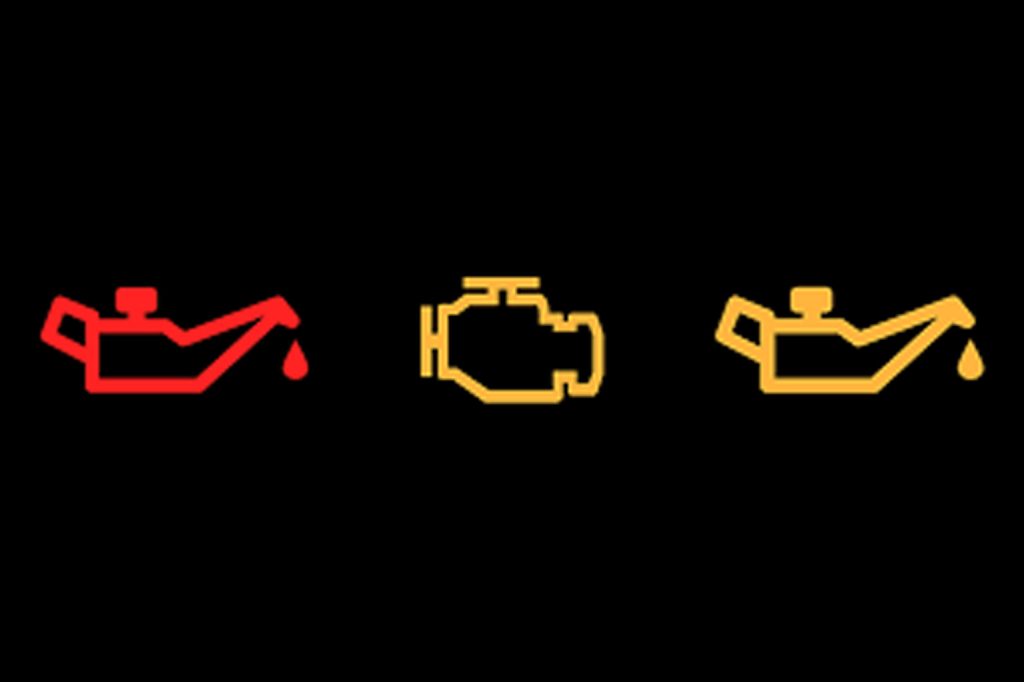
There is more than one type of oil warning light. You need to learn to distinguish between the following three scenarios:
| Warning Light Type | Color | Meaning | How Far Can You Drive? |
| Service Reminder Light | Yellow | Reminds you it’s time for an oil change | Can drive normally to a repair shop |
| Oil Level Light | Yellow | Oil level is low | Up to 60 kilometers |
| Oil Pressure Light | Red | Oil pressure is critically low | Stop immediately! |
Service Reminder Light (Yellow): This is merely a maintenance reminder triggered by mileage or time; it does not indicate an abnormality in oil quantity or pressure. You can continue driving normally, but it is advisable to schedule maintenance soon.
Oil Level Light (Yellow): This indicates the oil level has fallen below the normal range, but the engine still has basic lubrication. At this point, you can drive for a maximum of about 60 kilometers. You should head to the nearest gas station or repair shop to add oil as soon as possible.
Oil Pressure Light (Red): This is the most urgent situation, indicating that oil pressure is critically low and the lubrication system has almost completely failed. You must pull over to the side of the road immediately and turn off the engine. Continuing to drive could lead to complete engine destruction within minutes. There are real cases where driving just 3 kilometers after the oil pressure light came on resulted in a major engine repair costing 28,000 yuan.
3.2 Correct Emergency Procedures
If you see an oil warning light come on while driving, follow these steps:
Step 1: Stay calm and ensure safety. Turn on your hazard lights, gradually decelerate, check your mirrors, and find a safe spot to pull over.
Step 2: Turn off the engine. Park the vehicle on level ground and shut off the engine immediately.
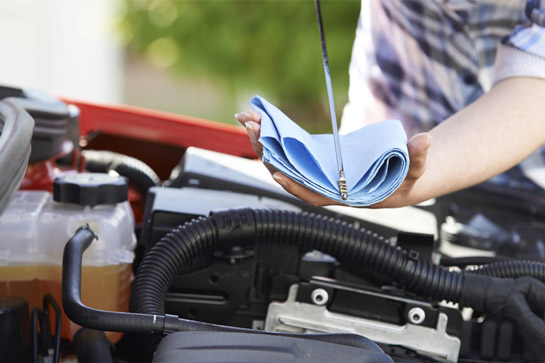
Step 3: Check the oil level. Wait 5-10 minutes for the oil to drain back into the oil pan, then pull out the dipstick to check. Wipe the dipstick clean with a paper towel, reinsert it fully, and pull it out again to see if the oil trace falls between the upper and lower marks.
Step 4: Make a decision based on the situation. If the level is indeed low and the warning light is yellow, you can add an appropriate amount of oil and then drive to a repair shop. If the warning light is red or you cannot locate any oil on the dipstick, do not continue driving and contact roadside assistance immediately.
IV. How to Check Engine Oil Correctly?
Many drivers do not check their oil correctly, sometimes leading to misjudgment and unnecessary actions. Here is professional advice:
4.1 The Best Time to Check
The most accurate time to check the oil is after the vehicle has been parked overnight and before starting the engine. At this point, the oil has completely drained back into the oil pan, yielding the most precise measurement. If you must check it with a hot engine, wait at least 10 minutes to allow sufficient time for the oil to return to the pan.
4.2 Correct Checking Procedure
- Park the vehicle on level ground. Sloped ground will cause inaccurate readings.
- Pull out the dipstick and wipe it clean. Use a paper towel to thoroughly wipe the entire blade.
- Reinsert the dipstick completely. Ensure it clicks into place.
- Pull it out again and observe the oil level. The normal oil level should be between the MAX (upper) and MIN (lower) marks.
4.3 An Easily Overlooked Misconception
Overfilling oil is more troublesome than underfilling! Excessive oil increases internal engine resistance, leading to power loss. Over time, it can also cause oil burning and increased carbon deposits, resulting in repair costs that are just as high. After an oil change service, always verify that the oil quantity is within the normal range.
V. How to Prevent Low Engine Oil?
Rather than panicking when a warning light comes on, it is better to take preventive measures in advance. The following advice is worth every car owner remembering:
5.1 Regularly Check the Oil Level
It is recommended to check the oil level at least once a month, and especially before long trips. Developing this habit takes only one minute but can save you thousands of yuan in engine repair costs.
5.2 Change Oil and Filters on Time
Engine oil does not last forever. It undergoes an oxidation reaction upon contact with air, gradually forming black, sticky sludge that not only loses its lubricating function but can also clog oil passages. Depending on the oil type, replacement intervals are as follows:
- Mineral oil: Every 5,000 kilometers
- Semi-synthetic oil: Every 7,500 kilometers
- Fully synthetic oil: Every 10,000 kilometers
5.3 Use Qualified Engine Oil
Using substandard oil or failing to change it on time can cause the oil film to rupture easily, directly leading to wear on the pistons and cylinder walls. Be sure to select oil that meets your vehicle manufacturer’s specifications and purchase it through legitimate channels.
5.4 Pay Attention to Signs of Abnormal Oil Consumption
If you find yourself needing to add oil frequently, this could be a sign of an underlying engine problem. Go to a professional repair shop for a comprehensive inspection promptly to prevent a small issue from turning into a major expense.
Conclusion: One Minute of Inspection for a Year of Peace of Mind
Returning to the original question: Can you drive with low engine oil?
The answer is clear: Check the light, adapt to the situation, and do not take risks. When a yellow service or level light comes on, you can drive a short distance to a repair point. When a red pressure light comes on, stop the car immediately and wait for assistance.
Looking for top-quality new or used cars? Trust DG Motors for fast, reliable service—or visit our Phnom Penh showroom today!