Contents
hide
- 1. Why Battery Health is Paramount
- 2. Core Method: Obtain the Official Battery Health Report (The Most Authoritative Route)
- 3. Practical On-Site Inspection Method: The Four-Step Verification Process
- 4. Special Considerations for Global Buyers & “Tesla Battery Health Test” Advice
- 5. Summary & Action Checklist
Purchasing a used Tesla is a smart investment, but the battery’s State of Health (SOH) is the core factor determining the vehicle’s value and future performance. This article provides you with a globally applicable, professional inspection methodology to help you precisely determine if the battery health is maintained above 90%, ensuring you get full value for your investment.
1. Why Battery Health is Paramount
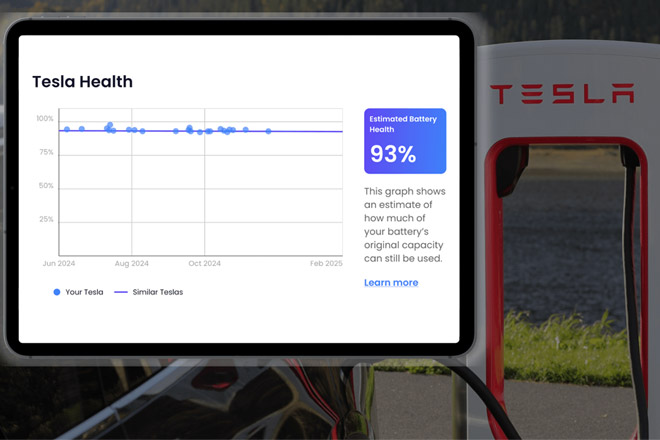
The Tesla battery pack is the vehicle’s most expensive component. Its health directly dictates driving range, charging speed, and long-term ownership costs. A battery with health above 90% typically means the vehicle can still maintain range close to its original capacity, and its degradation rate will remain low for years to come. For global buyers, especially in regions where the official service center network might be less extensive than in Europe or North America (for example, when evaluating a car for sale in Cambodia), understanding the battery’s condition beforehand is crucial to avoiding post-purchase risks and high repair costs.
2. Core Method: Obtain the Official Battery Health Report (The Most Authoritative Route)
The most accurate and widely recognized method is to obtain the official Tesla battery health report. This is not the simple range estimate displayed on the vehicle’s touchscreen, but a professional diagnostic report generated by Tesla’s backend systems.
- How to Obtain It: Whether you are in the United States, Germany, or Japan, you can request it via:
- Ask the current owner to contact official Tesla support through their mobile app to request the report directly.
- Schedule a paid vehicle inspection at a Tesla Service Center before finalizing the purchase, which should include detailed battery State of Health (SOH) data.
- Interpreting the Report: This report will clearly show the battery’s current maximum usable capacity as a percentage of its original new state. This is the gold standard for determining if it is “above 90%.” Ensure the report date is recent for accurate, timely data.
3. Practical On-Site Inspection Method: The Four-Step Verification Process
When an official report isn’t immediately available, you can conduct a comprehensive on-site evaluation using the following combined methods. These steps are highly effective for assessing used cars in any market, including when inspecting a car for sale in Cambodia.
Step 1: Check Basic Status Using Service Mode
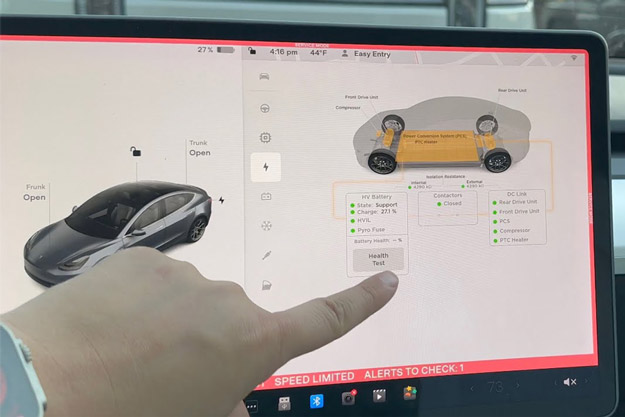
On the vehicle’s touchscreen, enter the “Software” settings. Press and hold the model badge (e.g., “Model 3”) for about 5 seconds until a text input box appears. Enter the code “SERVICE” to access the Service Mode. Within this menu, you can find the battery information screen. While it may not display a precise percentage health figure, it provides key indicators of battery status (like “Good” or “Fair”) and shows if the high-voltage battery system is fault-free. This is a quick preliminary screening before deeper checks.
Step 2: Calculate Full-Range Degradation Ratio
This is a simple and intuitive estimation method:
- Charge the vehicle to 100% (ensure the charge limit is set to maximum).
- Note the “Rated Range” or “Typical Range” value displayed on the touchscreen when fully charged.
- Compare this value to the official EPA or WLTP standard range for that model when it was new.
- Calculation Formula: (Current Full-Charge Mileage ÷ New Car Official Standard Range) × 100% ≈ Estimated Current Battery Health.
- Example: A new Model 3 Rear-Wheel Drive has an EPA range of 272 miles. If the used car you’re testing shows a Rated Range of 245 miles at 100% charge, the estimated health is about 90% (245 ÷ 272 ≈ 90%). Note: Official range standards differ by country; always use the standard data corresponding to the vehicle’s original market for calculation.
Step 3: Conduct a DC Fast Charging (Supercharger) Test
Battery aging reduces its ability to accept high-power charging. You can perform a fast-charge test:
- Use the vehicle until the battery level is around 20%.
- Connect it to a Tesla Supercharger or another high-power DC fast charger.
- Observe the charging power curve during the 20% to 80% charging process. A healthy battery can sustain high power (e.g., over 100kW) for a long period during this phase. A sharp drop in power before reaching 50% state of charge may indicate battery aging or suboptimal condition.
Step 4: Use a Professional OBD-II Scan Tool
This is a more advanced method for enthusiasts or professional appraisers. By connecting a compatible scan tool (like an aftermarket dedicated scanner) to the Tesla’s OBD-II port (usually under the dashboard near the driver’s knees) and using related software (e.g., Scan My Tesla), you can read raw data from the Battery Management System (BMS). This may include more detailed information on cell voltage balance, internal resistance, and estimated health. However, this operation requires specific knowledge, and data interpretation should be done cautiously.
4. Special Considerations for Global Buyers & “Tesla Battery Health Test” Advice
The situation becomes more complex for cross-border or cross-region purchases, such as a buyer from Australia considering a vehicle located in the United States or a car for sale in Cambodia.
- Regional Differences: First, identify the country or region where the vehicle was originally sold. Batteries in different markets (especially earlier models) may have variations in specifications, charging restrictions (e.g., vehicles for the Chinese market), or warranty terms. Always compare data based on the vehicle’s origin.
- Third-Party Professional Inspection: If you cannot inspect the car in person, it is highly advisable to commission a comprehensive Tesla battery health test from a reputable local independent vehicle inspection agency. This service is available in many countries, including Southeast Asia. A professional report can verify battery state and check for accidents, flood damage, etc. When dealing with a car in Cambodia, finding a credible inspection service with EV diagnostic capability is paramount.
- Cost vs. Value Consideration: The inspection itself incurs a fee (e.g., approximately $150-$300 in the United States; prices may vary in Southeast Asia), but this cost is negligible compared to potential losses of thousands of dollars due to battery issues. Make “completion of a professional battery test” a prerequisite in the purchase contract.
5. Summary & Action Checklist
To ensure you purchase a used Tesla with a healthy battery, follow this checklist:
- Primary Goal: Make every effort to obtain the official Tesla battery health report to confirm the exact percentage.
- On-Site Verification: Cross-verify using Service Mode screening, full-range calculation, and the fast-charge test.
- Seek Professional Help: For cross-border purchases or when you cannot inspect personally, always pay for a third-party Tesla battery health test. For instance, for a car for sale in Cambodia, it is essential to find a reliable local inspection service.
- Verify Warranty: Check the Vehicle Identification Number (VIN) to confirm if the battery and drive unit are still within the 8-year/120,000-mile (or corresponding kilometer) warranty period. This is a crucial value safeguard.
- Contract Clarity: Include key battery health guarantees (e.g., “Battery State of Health confirmed by official or third-party test to be not less than 90%”) as clauses in the purchase contract.
By following this globally applicable guide, you will be able to systematically and professionally assess the heart of a used Tesla—its battery—enabling you to make a confident and wise purchase decision, no matter where in the world your desired vehicle is located.
Looking for top-quality new or used cars? Trust DG Motors for fast, reliable service—or visit our Phnom Penh showroom today!