Contents
hide
- First, Understand the “Power Sources” Inside Your Car
- Second, Calculate the Charging Power of Your Devices
- Therefore, The Golden Formula for Safe Charging
- Furthermore, Many Safety Concerns Lie in Choosing Multi-port Chargers and Inverters
- Another Issue That Cannot Be Ignored: Draining the Car Battery
- Finally, My Safety Checklist and Experience Summary
Have you ever been on a long road trip, watching everyone in the car pull out their phones, tablets, and laptops at the same time, and then wondered to yourself: Exactly how many devices can I safely charge in my car? Will I blow a fuse? Or, will it drain the car battery and leave me stranded on the roadside?
As a car electronics modification enthusiast with over a decade of experience, I have tested dozens of car chargers and inverters. Today, I will combine my hands-on experience and professional knowledge to give you a clear, safe, and actionable answer. However, the answer is not a simple number. It depends on your vehicle, your devices, and how you manage power distribution wisely. More importantly, safety always comes first.
First, Understand the “Power Sources” Inside Your Car
Before counting devices, we must first understand the two main ways a car supplies power to electronic devices.
1. The 12V Cigarette Lighter Socket
This is the most common power take-off interface. The 12V socket in your car is actually connected to the vehicle’s main electrical system.
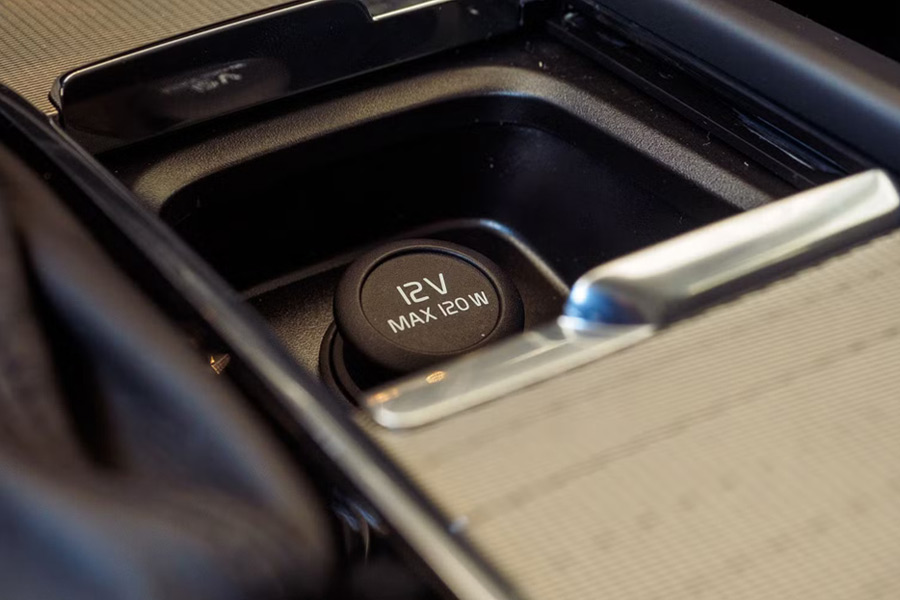
- Its power rating is limited. The 12V sockets in the vast majority of family cars are fitted with a fuse. The fuse’s rated current is usually 10A, 15A, or 20A.
- How to calculate the maximum power? You simply multiply voltage (12V) by current (A). For example, a 15A fuse theoretically supports a maximum power of 180W (12V × 15A). However, when the engine is running, the voltage usually reaches up to 14.5V, so the actual available power is slightly higher, but for safety, we always use 12V for our calculations.
- A key rule of thumb: Never fully utilize this upper limit. It is best to keep the continuous load within 80% of the fuse’s rated value. That means, for a 180W socket, the recommended continuous safe load is kept around 144W. This prevents the interface from overheating and the fuse from blowing unexpectedly.
A special reminder: You can consult your vehicle’s owner’s manual, or open the fuse box cover to find the fuse corresponding to the cigarette lighter to confirm its precise rated current value. This is the most authoritative method.
2. Original Factory USB Ports
Many new cars nowadays come with built-in USB-A or USB-C ports.
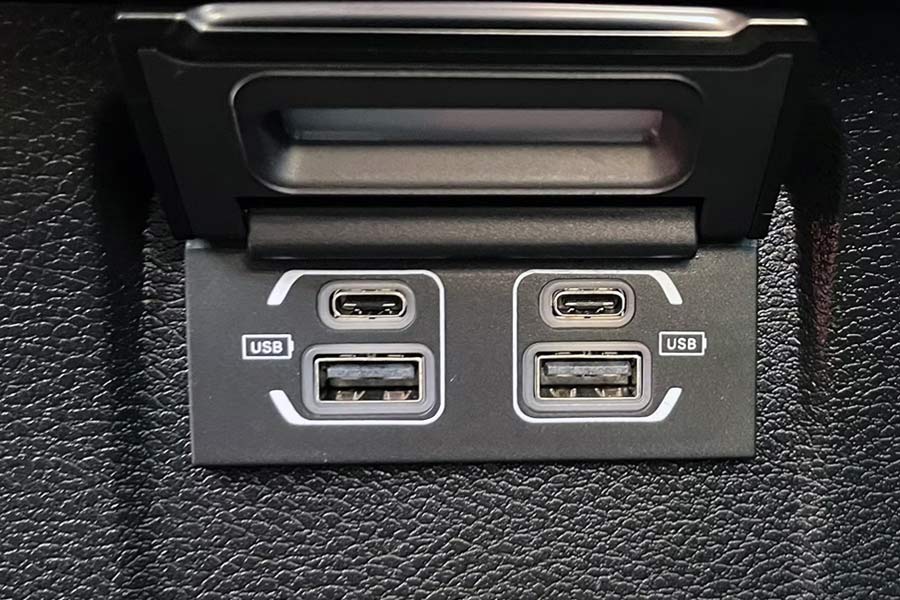
- USB-A ports in older car models generally only provide 5V/1A or 5V/2.1A output, which is around 5W to 10W. They charge very slowly.
- USB-C ports in newer models may support the PD fast-charging protocol, with power reaching 18W, 45W, or even higher.
- However, relying on the original car USB ports is not flexible. Their output usually cannot meet the demand for charging multiple devices at maximum speed. Therefore, we mainly focus on using the 12V cigarette lighter socket to expand power supply capability.
Second, Calculate the Charging Power of Your Devices
Knowing how much power you can supply, the next step is to see how much power your devices actually need.
- Smartphones: Standard charging 5W-10W. But nowadays, almost all phones support fast charging, with actual demand typically between 18W and 27W. Some flagship models can even reach 45W or higher.
- Tablets: They have larger batteries, with charging power generally between 10W and 30W. For example, the iPad Pro has a fast-charging power of about 30W.
- Laptops: These are major power consumers. USB-C charging power for thin-and-light laptops is typically between 45W and 65W. High-performance notebooks require 90W or even over 100W.
- Other devices: Such as dashcams (about 5W), action cameras, wireless earbuds charging cases (as low as 2W), etc. These are small loads, but every little bit adds up.
It’s worth noting that the charging power labeled on a device is its maximum demand. During actual charging, power changes dynamically based on battery level and temperature. But to ensure safety once and for all, we always estimate based on maximum power.
Therefore, The Golden Formula for Safe Charging
Now, we can plug everything into a simple formula:
(Wattage of Device 1 + Wattage of Device 2 + … ) ≤ Safe Continuous Power of the 12V Socket
Let’s look at several real-life scenario simulations to give you a better concept.
Scenario 1: Family Road Trip
You and your family are fully loaded with five people, each with a smartphone, plus two kids in the back watching cartoons on their tablets.
- Device List: 5 smartphones (assuming 20W fast charging each) + 2 tablets (25W each).
- Total Power Demand: (5 × 20W) + (2 × 25W) = 150W.
- If your 12V socket fuse is 15A (180W), the safe continuous load is about 144W. This 150W demand slightly exceeds the safety margin.
What to do? This doesn’t mean it’s impossible, but there is a risk. You can use a high-quality multi-port car charger with a total power limit of 150W. I once did a test during a summer road trip, using a certain brand’s 150W multi-port charger to power 7 devices. The charger got noticeably warm but did not trigger protection. However, for absolute safety, I recommend switching one of the phones to low-power charging, or temporarily disconnecting one tablet, keeping the total load within 140W. In other words, in this scenario, the safe number is about 6 to 7 regular devices, provided the total wattage is strictly controlled.
Scenario 2: Mobile Office Combo
You and your front passenger both need to use laptops to handle urgent work.
- Device List: 2 laptops (65W each), plus two smartphones (20W each).
- Total Power Demand: (2 × 65W) + (2 × 20W) = 170W.
- This is very close to, or already exceeds, the 144W safety limit of a 15A socket. Therefore, absolutely do not plug both laptops into the same cigarette lighter socket simultaneously through a single multi-port charger.
A more professional approach: Use an inverter connected directly to the car battery with low-voltage protection to provide 220V AC power for the laptops. Or, look for a dual-port car charger that supports higher power (but the regular 12V socket is still limited by its fuse). Most importantly, when using high-power devices, be sure to keep the engine running. Otherwise, the car battery will be drained very quickly.
Scenario 3: Fully Loaded with Digital Gear
A group of friends goes out for a shoot, carrying drones, cameras, action cameras, phones, etc.
- Device List: 4 phones (20W), 2 drone battery chargers (40W each), 1 laptop (65W), 1 camera (10W).
- Total Demand: 80W + 80W + 65W + 10W = 235W. This clearly exceeds the capability of any single cigarette lighter socket.
In this case, there is no magical “one-to-many” splitter device that can solve this safely. Forcing it will only blow the fuse, or even cause a fire. You need to upgrade the vehicle’s electrical system, such as installing a dedicated second deep-cycle battery and an independent power supply system. But this is an advanced modification and must be performed by a professional. Most importantly, never replace a blown fuse with copper wire or other metal. This is equivalent to abolishing the safety protection and is extremely dangerous.
Furthermore, Many Safety Concerns Lie in Choosing Multi-port Chargers and Inverters
The quality of car chargers on the market varies greatly. As an experienced user, I emphasize the following points:
- Buy certified products with clearly stated total power limits. A charger that claims to have 4 USB ports but a total output of only 24W will only deliver 6W per phone if you plug in 4 phones simultaneously. It will not overload, but charging will be extremely slow. A truly high-performance multi-port charger will clearly label its total output, such as 120W or 150W, and feature intelligent power distribution, over-current, over-temperature, and short-circuit protection.
- Avoid using cheap, uncertified “cigarette lighter splitters”. They have no power limit themselves; they just expand the physical connections. If you plug in multiple high-power charging adapters, the total current can easily exceed the socket’s fuse rating. The result is a blown fuse, and that’s the good outcome. The worse scenario is that the socket wiring harness overheats, melting the insulation, causing a short circuit or even a vehicle fire.
- Using an inverter requires extra caution. If you need to charge a laptop, you might buy a modified sine wave inverter that plugs into the cigarette lighter, with its maximum output typically limited to 150W. Leave ample headroom when using it, and monitor the temperature of the inverter and the socket with your hand. If it’s too hot to touch, stop immediately. Moreover, using the inverter with the engine off will drain the battery extremely quickly, soon causing battery undervoltage and making it impossible to start the engine.
Another Issue That Cannot Be Ignored: Draining the Car Battery
You may have noticed that I always mention “keep the engine running” when using the calculations above. This is because, when the engine is off, the power from the car’s 12V socket comes entirely from the starter battery.
The starter battery is designed for short bursts of high-current discharge (to start the engine), not for routine deep discharge. Once it is drained, you will be stranded. Additionally, repeated deep discharging severely shortens the battery’s lifespan.
- Safety Suggestion: If you often charge devices for long periods with the engine off, you can add a cigarette lighter plug with a voltage display. When the battery voltage drops to around 12.2V, it’s time to start the engine. Dropping below 11.8V means deep discharge and causes significant harm.
- Authoritative Advice: Almost all vehicle manufacturer manuals warn: Do not use automotive electrical accessories for extended periods without the engine running.
Finally, My Safety Checklist and Experience Summary
Based on years of practical experience and professional knowledge, I summarize how to safely “charge multiple devices” into the following steps. Please be sure to follow them:
- Determine your socket’s limit. Locate the cigarette lighter fuse, confirm its amperage, and calculate 80% of that for safe continuous power.
- Tally up your devices’ maximum power. List all devices that need charging and add up their fast-charging wattages.
- Match with a high-quality, total-power-limited charging hub. Choose a multi-port car charger whose total output is close to but always leaves a safety margin, and ensure it has various protection mechanisms.
- Dynamically manage the load. If total demand slightly exceeds the limit, you can adjust the devices’ charging settings (e.g., turn off fast charging) or stagger charging. In other words, you don’t need all devices to charge from 0% to 100% simultaneously.
- Keep the engine running. Start the car when under high load or when charging continuously for more than 15 minutes.
- Check temperatures regularly. Feel the charger, plug, and socket for overheating with your hand. If there is abnormal heat or a burning smell, unplug immediately.
So, back to the original question: “How many devices can I safely charge in my car?”
There is no fixed number. For you, it might be 4 phones plus 1 tablet (safe on a 120W socket). For another car owner, it might be just 2 laptops (requiring a dedicated solution). But as long as you follow the golden formula and safety guidelines above, you can confidently calculate your own safe number, making every trip fully powered and completely worry-free.
Looking for top-quality new or used cars? Trust DG Motors for fast, reliable service—or visit our Phnom Penh showroom today!