Contents
hide
- Engine Cooling System: The Number One Challenge in High Temperatures
- Sand and Dust: The Invisible Killer of Engines
- Air Conditioning System: Sustained High-Load Operation
- Lubricants and Fluids: Entering the Deterioration Period Ahead of Time
- Tires: Facing Hot Road Surfaces and Sharp Gravel
- Paint and Interior: The Relentless Assault of UV Rays
- Electrical System and Chassis: The Overlooked Details
- Desert Vehicle Maintenance Quick Checklist
- Reliable Maintenance Makes Chinese Vehicles More Durable
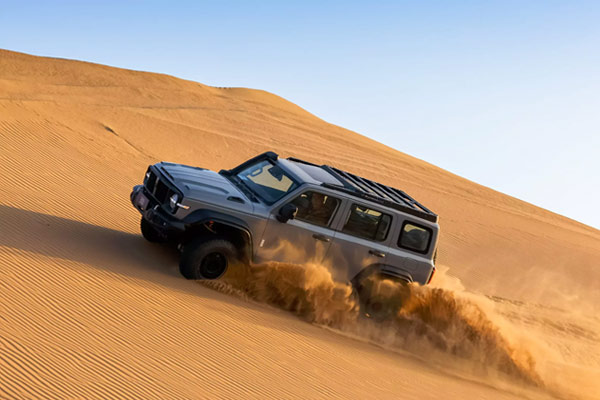
Amid blistering heat and swirling sand, your vehicle is silently enduring a harsh test. As a Chinese auto exporter deeply rooted in the Middle East and African markets, Jinyuautos has witnessed countless vehicles charging across sand seas. The common faults we discover are often not caused by quality issues with the vehicle itself; the real reason is that owners overlook the special maintenance demands brought by the desert climate. Today, drawing on years of hands-on field experience, we will share a maintenance guide that can truly help you. These suggestions come from our technical team and genuine feedback from local repair partners.
Engine Cooling System: The Number One Challenge in High Temperatures
In the desert, midday temperatures easily exceed 45°C. Under such conditions, the engine is extremely prone to overheating, and the coolant also evaporates faster due to the intense heat. Therefore, regularly checking the coolant level is the first habit you need to develop. At the same time, be sure to use a high-boiling-point ethylene glycol-based coolant, which resists boiling far better than ordinary coolant.
In addition, sand and dust can quietly clog the radiator fins, directly reducing heat dissipation efficiency. When performing repairs, our technicians have discovered countless times that overheating problems originate from this unremarkable layer of accumulated dust. So, after every drive on sand, it is crucial to rinse the radiator surface with low-pressure air or soft water.
Sand and Dust: The Invisible Killer of Engines
You cannot see them with the naked eye, but the desert air carries countless tiny sand particles that are desperate to worm their way inside the engine. First, you need a high-quality air filter. If the filter is of poor quality or not properly sealed, sand particles will force their way straight in, directly causing severe wear to the cylinder walls and piston rings. This is why we repeatedly emphasize: never cut costs on the air filter.
More importantly, you must shorten the replacement interval. Under normal road conditions, replacing it every 10,000 kilometers might be sufficient, but in a desert climate, we strongly recommend inspecting or replacing it every 5,000 kilometers. Furthermore, if you often drive deep into sandy areas, installing a cyclone pre-filter is an excellent choice; it can separate large sand particles in advance, greatly reducing the burden on the main filter element. Many Chinese-brand SUVs and pickups exported by Jinyuautos come equipped with multi-stage filtration systems from the factory. This is an in-depth optimization that Chinese automakers have made for harsh environments. But even so, diligent maintenance remains your bottom line.
To give a real-life example, one of our clients in Riyadh, Saudi Arabia, once neglected to check the air filter after a sandstorm, which resulted in severe engine cylinder scoring. This entirely avoidable repair cost him nearly 20,000 RMB.
Air Conditioning System: Sustained High-Load Operation
The desert’s extreme heat forces the air conditioning system to run at full capacity. Under such prolonged operation, the condenser easily attracts sand, dust, and insects, causing the cooling effect to drop dramatically. Therefore, our clear advice is to clean the condenser surface every quarter. At the same time, regularly check the refrigerant pressure; even a slight deficiency will make the compressor start and stop frequently, accelerating damage.
Another commonly overlooked component is the cabin air filter. Once it gets clogged, the air output will not only smell unpleasant but the airflow volume will also drop noticeably. Imagine how dangerous it would be if the air conditioning suddenly failed in a 50°C cabin. Therefore, you would do well to replace the cabin air filter when performing engine maintenance.
Lubricants and Fluids: Entering the Deterioration Period Ahead of Time
Extreme heat is the biggest enemy of oil and fluids; it dramatically accelerates oil oxidation. When engine oil becomes thinner, its high-temperature shear resistance decreases, meaning the protective layer it forms for the engine is weakening. Thus, choosing a fully synthetic oil with outstanding high-temperature stability is the wise move. Grades such as 5W-40 or 10W-40 are generally well-suited to desert operating conditions, but always follow your vehicle’s owner’s manual as the final authority.
Another crucial action is to shorten the oil change interval. A standard 10,000-kilometer maintenance interval might mean the engine runs in a state of “dry friction” for the last 3,000 kilometers in the desert. We recommend doing a complete oil change between 5,000 and 7,000 kilometers. Moreover, transmission fluid and brake fluid should not be ignored; both are hygroscopic to some extent. The huge temperature difference between day and night in the desert can easily create condensation inside the housings. Once the fluid contains water, its boiling point plummets, and braking performance deteriorates. For this reason, it is essential to use professional equipment to test the brake fluid’s moisture content every year.
Tires: Facing Hot Road Surfaces and Sharp Gravel
Tarmac or gravel road surfaces scorched by the blazing sun often reach temperatures above 70°C. The air inside the tires expands as it heats up, so tire pressure will rise noticeably. Over-inflation not only reduces grip but also greatly increases the risk of a blowout. Therefore, always measure the tire pressure when the tires are cold, and adjust accordingly based on your load.
At the same time, the sharp gravel at the desert’s edge will mercilessly gnaw at the tread. You need to check the sidewalls more frequently, as well as deep inside the tread pattern, for any cuts or embedded stones. Based on our experience, if the tread depth is less than 3 millimeters, you should decisively replace the tire, because the remaining thin layer of rubber can hardly resist stone punctures. Additionally, don’t forget to check the spare tire. Many car owners only discover that the spare tire has been completely deflated when they get stuck and need to change it.
Paint and Interior: The Relentless Assault of UV Rays
The intensity of ultraviolet radiation in desert regions is far higher than in temperate zones. Under this high-energy radiation, the clear coat on the paint will gradually oxidize and fade. If left unattended, the car body will turn dull and lusterless within a few years. Therefore, waxing the car body or applying a paint sealant every three months is an excellent form of protection. This is not just for aesthetics; it serves as a sacrificial protective layer.
As for the interior, the dashboard and leather seats suffer equally. The surface temperature of a dashboard exposed to the sun can literally fry an egg, and over time, plastic parts will become brittle and crack. So, even if you stop for only ten minutes, try to use a windshield sunshade. Meanwhile, installing high-quality heat-insulating film can fundamentally reduce heat build-up inside the car.
Electrical System and Chassis: The Overlooked Details
High temperatures accelerate the evaporation of the electrolyte inside the battery. Even if you use a maintenance-free battery, the terminals are more prone to corrosion, which can lead to starting difficulties. Therefore, at every maintenance session, have a technician clean the battery terminals and apply protective grease. At the same time, carefully check the engine wiring harness. High heat tends to make the insulation tape brittle and fall off; exposed wires, chafed by sand particles, can easily cause a short circuit. For vehicles, especially those fitted with additional spotlights, winches, or modified horns, the safety of the wiring must be regularly verified.
Regarding the chassis, the suspension bushings and ball joint dust boots are constantly being ground down by sand particles. Once a dust boot is torn, sand mixes into the grease, creating an abrasive paste effect that rapidly causes loose ball joints and produces abnormal noises. So, after you joyfully charge over a sand dune, remember to find a place to thoroughly clean the chassis. Use plenty of water to flush the sand out of the crevices and lubricate the key joints.
Desert Vehicle Maintenance Quick Checklist
To leave a deeper impression, we have compiled a list of the most essential interval recommendations. You can treat it as an on-the-go memo.
| Maintenance Item | Key Action | Jinyuautos Recommended Interval |
| Air Filter | Inspect/Replace, check immediately after sandstorms | Every 5,000 km or depending on conditions |
| Engine Oil & Oil Filter | Replace with fully synthetic oil | 5,000 – 7,000 km |
| Air Conditioning System | Clean condenser, replace cabin filter | Every quarter or when seasons change |
| Tires | Check air pressure and wear | Every two weeks and before long trips |
| Coolant | Check level and boiling point | Monthly check |
| Brake Fluid | Test moisture content | At least once a year |
| Chassis | Wash off accumulated sand, inspect dust boots | After every desert crossing |
Reliable Maintenance Makes Chinese Vehicles More Durable
The desert is not terrifying; the real danger is inadequate preparation. Today, Chinese automobiles have made significant progress in areas such as thermal management, air filtration, and UV-resistant paint. Every carefully selected export model we offer has a solid foundation. But this absolutely does not mean that maintenance can be omitted. On the contrary, targeted maintenance can amplify a vehicle’s desert survival capability to the maximum.
Jinyuautos is not only dedicated to providing you with cost-effective Chinese vehicles; through these frontline technical insights, we hope to help you reduce vehicle operating costs and extend the lifespan of your car. If you are preparing to import a pickup or SUV from China that can handle extreme climates, please feel free to contact us at any time. Our team of experts has long been rooted in the core markets of the Middle East and Africa, and we can answer all your maintenance concerns based on our personal experience.
The recommendations in this article are based on the hands-on experience of the Jinyuautos technical team in high-temperature, sandy environments and data collected from local service stations. Vehicle characteristics vary by model; please always follow the original manufacturer’s owner’s manual for specific maintenance operations.
Looking for top-quality new or used cars? Trust DG Motors for fast, reliable service—or visit our Phnom Penh showroom today!