Contents
hide
- 1. A seemingly straight road is actually full of tiny “imperfections”
- 2. Persistent external disturbances: crosswinds and road feedback
- 3. The sensor’s “over-vigilance” and precision limitations
- 4. The “original sin” of control algorithms: the fate of PID regulation
- 5. The boundary of human-machine co-driving: physical reminder for hands-off detection
- Is this continuous correction normal? When should you be alert?
Have you ever had this experience: on an empty highway with the Lane Keeping Assist system activated, the road stretches straight into the distance, but your steering wheel, like a nervous novice driver, constantly makes subtle left-right adjustments. This seemingly “wandering” or “twitching” motion often makes drivers wonder — is my car malfunctioning, or is the system inherently this “neurotic”?
In fact, this is by no means a malfunction but rather normal behavior of the system under certain technical limitations. Next, we will delve into the five core reasons behind this, taking you into the mysteries of modern driver assistance technology.
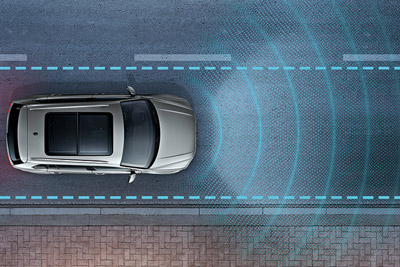
1. A seemingly straight road is actually full of tiny “imperfections”
First, we need to dispel a common misconception: there is no absolutely straight road in the world.
Due to drainage requirements, highway surfaces are designed with a slight crown, higher in the middle and lower on the sides. At the same time, years of heavy vehicle traffic and minor foundation settlements create undulating waves or extremely slight curvatures that are imperceptible to the human eye.
In other words, what you see as a perfect straight line is, to the cameras and sensors of the Lane Keeping Assist system, a complex path requiring constant correction. The system’s goal is to precisely pin the vehicle in the exact center of the lane. Therefore, to counteract the inherent road slope or curves invisible to the naked eye, it must continuously issue steering commands. This is the most fundamental reason for the constant corrections.
2. Persistent external disturbances: crosswinds and road feedback
Beyond the road itself, a moving vehicle is constantly subjected to external disturbances.
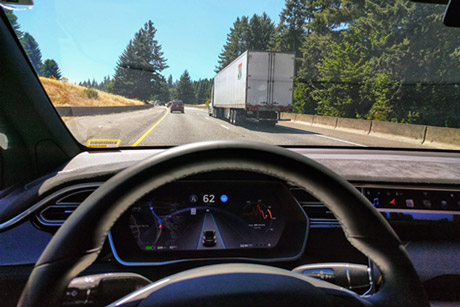
For instance, sudden crosswinds, or the aerodynamic push from a large truck speeding by in the adjacent lane, can push the vehicle off its intended path. Additionally, changes in road friction coefficient and tiny inequalities in tire pressure continuously tug at the vehicle’s trajectory.
That is why the frequent corrections you feel are actually the system counteracting these external disruptions at the millisecond level. Without such continuous “micro-operations,” the vehicle would gradually drift out of its lane due to accumulated deviations. This active intervention is precisely the system dutifully protecting your safety.
3. The sensor’s “over-vigilance” and precision limitations
Another critical factor lies in the physical characteristics of the sensors. Currently, the vast majority of Lane Keeping Assist systems on the market rely on a monocular or multi-camera setup behind the windshield.
Imagine the camera capturing lane markings at high speed: any slight changes in light and shadow, faded road markings, or even color differences in asphalt joints may be interpreted by the algorithm as jittering of the lane lines. As a result, the lane centerline identified by the system itself trembles at high frequency. To follow this constantly shifting “virtual center point,” the steering wheel naturally makes corresponding continuous adjustments.
It is worth noting that this “correction to fix an error that didn’t need correcting in the first place” is a true reflection of the system’s perceptual limits. It is not stupidity, but rather a limitation of current sensor physical accuracy and algorithmic interpretation logic.
4. The “original sin” of control algorithms: the fate of PID regulation
From a deeper technical core perspective, this continuous correction originates from the control algorithm used by the system. Most Lane Keeping Assist systems employ PID control logic.
Simply put, the PID algorithm is like an extremely obsessive proofreader:
- It sees the deviation (P): the vehicle is a bit off the centerline, so it immediately commands the steering wheel to turn back.
- It eliminates accumulated error (I): even if the deviation is extremely tiny, if that tiny deviation persists for a few tenths of a second, the system will increase the correction force because of the “error integral,” determined to erase this minuscule error completely.
- It predicts the trend (D): the system perceives a “sign” of deviation and intervenes with damping in advance.
Therefore, even when the vehicle is in a near-perfect centered state, the tiny historical errors accumulated in the system’s “I integral term” still prompt the steering actuator to push and pull continuously, striving to reach the mathematically absolute ideal value of zero. It is no exaggeration to say that this algorithm is inherently designed to “keep moving.”
5. The boundary of human-machine co-driving: physical reminder for hands-off detection
Finally, this is closely related to safety strategy.
When designing Lane Keeping Assist systems, engineers face a dilemma: they need the steering wheel to turn to control the vehicle, yet they cannot let you mistake this for fully autonomous driving and take your hands off completely.
Thus, a delicate balance emerges. Through these high-frequency, small-amplitude steering corrections, the system is actually conveying a clear physical signal to the driver: “I am working, but I do not guarantee perfection; you must keep your hands on the wheel.” On many models, hands-off detection works precisely by sensing the slight opposing force you apply to the steering wheel to confirm you are in a state of readiness. If the steering wheel remained perfectly still on a straight road, it would more easily lull one into a false sense of security, which would be extremely dangerous.
Is this continuous correction normal? When should you be alert?
In summary, in the vast majority of cases, the high-frequency fine-tuning of the Lane Keeping Assist system on straight roads is absolutely normal. It is an inevitable physical response to counteract road camber, crosswinds, and to follow highly sensitive algorithmic logic.
However, if you notice the corrections suddenly become drastic, exhibiting jagged rapid left-right swings, or the system is fighting you for the steering wheel without the turn signal being activated, then you need to be vigilant. This could be due to a dirty camera, fogged windshield, or severely worn lane markings causing the system to misjudge. In such a situation, immediately take over the steering wheel, turn off the assist system, and go to a professional service center for inspection.
In conclusion, there is no need to feel anxious about those “little movements” of the steering wheel. They are not only not a malfunction, but rather a dynamic safety net that modern cars, using imperfect hardware, strive to build for you. It is precisely because of these seemingly neurotic continuous corrections that our long-distance driving has become more relaxed and safe.
Looking for top-quality new or used cars? Trust DG Motors for fast, reliable service—or visit our Phnom Penh showroom today!