Contents
hide
- 1. First, Settle the Question of “Are You Eligible to Drive?”
- 2. Core Rules That Must Become Muscle Memory
- 3. Three Types of High-Risk Scenarios You Must Actively Avoid
- 4. After an Accident: Secure Evidence First, Discuss Everything Else Later
- 5. Traffic Police Checkpoints: Complete Documents Are Your Biggest Leverage
- Final Thoughts
When driving in Cambodia, the biggest risk is often not the road conditions themselves, but the gap between believing you are legal and actually not being legal. A rental company handing you the keys does not mean your driver’s license is legally recognized, and it certainly does not mean the insurer will be on your side if something happens. In 2025, Cambodia recorded 2,345 road traffic accidents nationwide, causing 1,467 deaths and 3,213 injuries—about four people dying on the roads every day on average. Speeding was directly linked to nearly half of all accidents, while more than half occurred at night. The following guide focuses on legality, core rules, high-risk scenarios, and accident response, with the aim of helping you fill in the most common pitfalls before you set off.
1. First, Settle the Question of “Are You Eligible to Drive?”
Cambodia drives on the right, the same as mainland China, so the basic framework of traffic rules is not unfamiliar. What really needs to be clarified is the legal validity of your driver’s license.
A mainland Chinese driver’s license cannot be used directly in Cambodia. The Chinese Embassy in Cambodia has explicitly warned of this; if you really need to self-drive, you should hold a Cambodian driver’s license or an international driving permit. The problem is that mainland China has no official body that issues International Driving Permits (IDPs) under the 1949 Geneva Convention, and “international driver’s licenses” obtained through informal channels have no legal validity in Cambodia.
Cambodia legally recognizes IDPs issued by contracting states to the 1949 Geneva Convention, but requires them to be presented together with a valid domestic driver’s license. In actual enforcement, however, many Cambodian traffic police are not familiar with IDPs; even if you hold compliant documents, you may still be asked to produce a Cambodian driver’s license. For drivers staying longer or planning to self-drive beyond a short trip, converting a foreign license into a Cambodian license is the safer choice. Conversion requires the original Chinese driver’s license, notarization and authentication by the Cambodian embassy or consulates in China, a visa valid for no less than six months, photos, and a medical examination certificate. Fees range from US$65 to US$280 depending on the processing channel, and the license is valid for one year.
There is an easily misread space in the rules on motorcycles: motorcycles under 125cc do not require a driver’s license (riders must be at least 15 years old and carry identification), while those 125cc and above require the appropriate license. But “license-free” does not mean “protected”—if an accident occurs, lacking the appropriate driving qualification may still become grounds for an insurer to deny a claim.
A practical test: before renting a car, confirm two things in writing with the rental company—whether the license combination you hold is recognized under Cambodian law, and whether, under that license status, the vehicle insurance is complete and valid. Oral promises are not enough; written confirmation is the basis for your claim after an accident.
2. Core Rules That Must Become Muscle Memory
Speed limits and enforcement priorities. In urban areas, the speed limit is 40 km/h for light vehicles and 30 km/h for motorcycles; outside urban areas on national roads, it is 90 km/h for cars and 70 km/h for motorcycles; on the Phnom Penh–Sihanoukville Expressway, the maximum for light vehicles is 120 km/h. Speeding is the number-one cause of road deaths in Cambodia; in 2025 it was linked to 49% of accidents, continuing to rise from 43% the previous year. The government is already studying the introduction of speed monitoring systems, which means future enforcement against speeding will only become stricter, not looser.
The cost of drunk driving is far higher than the fine itself. The legal blood alcohol concentration limit is usually 0.05% (breath 0.25 mg/L), with stricter standards for professional drivers. The official fine range is 200,000 to 800,000 riel, and may be accompanied by license suspension. More importantly, drunk driving is an explicit exclusion under insurance contracts—once alcohol is involved, the insurer can legally deny the claim, and you bear all losses yourself.
Helmets and seat belts are not suggestions; they are mandatory conditions. Motorcycle drivers and passengers must both wear helmets, and violators are fined 15,000 riel per person; car drivers and front-seat passengers must wear seat belts. What matters is the consequence: motorcycles account for 85% of registered vehicles in Cambodia but contribute 70% to 80% of traffic deaths, and the helmet-wearing rate in accidents is only about 40%. Driving while holding a phone (including operating it while waiting at a red light) is also a violation, with fines of 25,000 to 50,000 riel.
3. Three Types of High-Risk Scenarios You Must Actively Avoid
Scenario 1: “Coexist” with motorcycle traffic, rather than “compete” with it
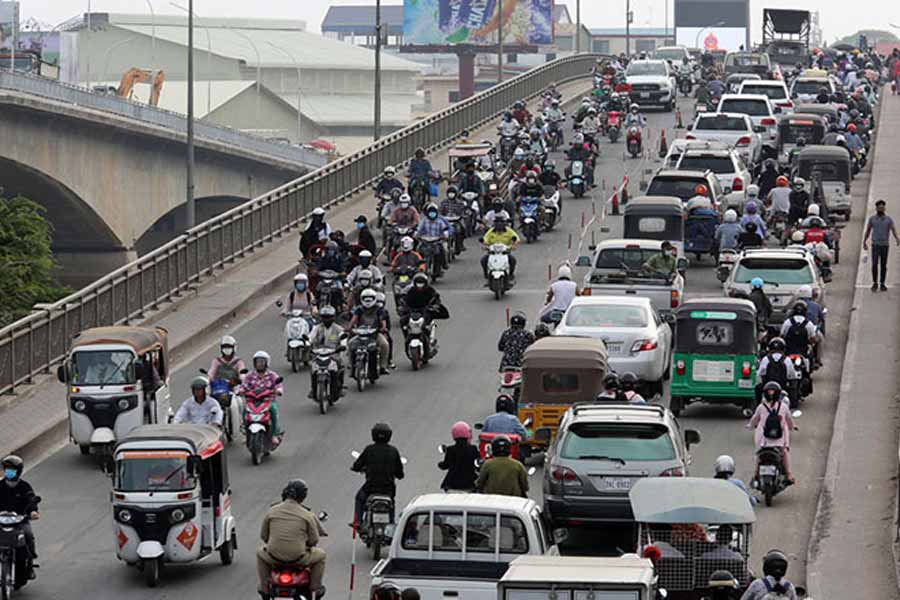
The behavior patterns of motorcycles on Cambodian roads need to be treated as an environmental constant, not as occasional anomalies. Riding against traffic, traveling at night without lights, and suddenly emerging from side roads or between parked vehicles are all high-frequency behaviors. When driving a car, your predictions about motorcycles should default to the worst-case assumption: assume the other party will not yield, will not signal, and will not look. Speeding and disregard for right-of-way are the leading causes of accidents, and these two are especially concentrated in motorcycle behavior. Rather than arguing over who was right or wrong after an accident, leave an extra second of reaction margin before one happens.
Scenario 2: Night driving, especially outside urban areas
More than half of fatal accidents occur at night. Nighttime risks stack up: many motorcycles lack lights or have failed lights; oncoming high beams cause glare; potholes and obstacles are almost impossible to identify in advance in the darkness; and the density of drunk drivers also rises significantly. If your itinerary allows, compressing driving time as much as possible into the 6:30 a.m. to 5:30 p.m. window is the most direct way to reduce risk. Long-distance night driving in Cambodia is not a matter of “being a bit more tired”; it is a change in the order of magnitude of risk.
Scenario 3: The rainy season (roughly May to October)
The danger of the rainy season is not limited to “slippery roads.” The first rain after a long dry spell lifts oil and grime that have accumulated on the road over time, forming a slippery film that is very hard to judge by eye; it is often slicker than the road surface after continuous rain. Across Cambodia’s road network, apart from the Phnom Penh–Sihanoukville Expressway, many roads experience standing water, landslides, and even bridge closures under sustained heavy rain. Phnom Penh’s urban area frequently floods after heavy rain, and some sections of National Road 4 are especially badly affected by standing water. The principle for crossing flooded sections is “look first, slow down second, pass third.” Do not risk entering when you cannot judge the depth; if the vehicle stalls in water, never restart it—immediately leave the vehicle, move to a safe place, and call for rescue.
4. After an Accident: Secure Evidence First, Discuss Everything Else Later
Organized emergency rescue coverage outside major cities in Cambodia is limited, and response capacity within cities is not ample either. After an accident, you are the first person responsible.
Core emergency numbers: Police 117 (when traffic police are needed, call and ask to be transferred to traffic police), Ambulance 119, Fire 118. The rapid response hotline for foreigners is 031 201 2345 / 031 601 2345. English-speaking operator capacity for these numbers is limited, so saving them in advance and preparing simple English or Khmer keywords will be practically helpful.
The sequence of actions at the accident scene should be: if anyone is injured, call 119 first; at the same time, call 117 to request traffic police attendance; while waiting, photograph and document the vehicle positions, damaged areas, the other party’s documents, and the scene environment. Before the police record is completed, avoid private cash settlements—without an official accident record, it will be extremely difficult to claim from the insurer afterward.
On insurance, Cambodian law requires motor vehicles to carry third-party liability insurance, but the real risk lies in license compliance. Insurers state clearly that a fatal accident itself is not an absolute ground for denying a claim, but drunk driving, drug driving, lack of a compliant driver’s license, or criminal conduct are grounds for denial. In other words, if you drive while your license status is not recognized, the financial consequences after an accident may fall entirely on you. Annual comprehensive insurance for a private car is about 1% to 1.3% of the vehicle’s value; for a US$20,000 car, the annual premium is about US$200 to US$230—but only on the premise that your driving qualification itself can withstand the insurer’s review.
5. Traffic Police Checkpoints: Complete Documents Are Your Biggest Leverage
It does happen that Cambodian traffic police ask foreign drivers for extra payments during roadside checks, and there are public records of traffic police being investigated and disciplined for suspected solicitation of bribes. This does not mean every checkpoint will necessarily be like that, but you need to be procedurally prepared for it.
The most effective defense is for your documents themselves to be compliant and complete. If your driver’s license, vehicle registration document, insurance certificate, and helmet status are all in order, you are in the strongest position in the conversation. When showing documents, try to hold the originals in your own hand for display, and avoid letting the other party take them directly. If the officer cites a specific violation, you can calmly ask which regulation was violated and request an official fine receipt—official tickets have a fixed format and amount, while arbitrarily priced “fines” often lack any verifiable basis. Carrying only an appropriate amount of cash and avoiding exposing large bills under pressure can also reduce, to some extent, the possibility of being over-solicited.
Final Thoughts
The value of self-driving in Cambodia lies in freedom, but that freedom must be premised on clear legal eligibility, confirmed insurance coverage, and active avoidance of risk scenarios. For Chinese drivers, the question that most needs to be thought through in advance is not “are the roads easy to drive?” but “is my driver’s license truly valid on these roads?” On that premise, choosing a vehicle that does not compromise on passive safety—structural strength, airbag configuration, braking and stability systems—is a meaningful bonus, not a substitute. If your itinerary consists mainly of long intercity trips, or if this is your first time driving in Cambodia, hiring a local driver remains the choice with the highest risk-adjusted return; it bypasses at once several of the most troublesome issues: license legality, insurance uncertainty, nighttime and rainy-season risks, and roadside enforcement friction. Do the legality checks and scenario avoidance in this guide well, and leave the rest to defensive driving itself.
Looking for top-quality new or used cars? Trust DG Motors for fast, reliable service—or visit our Phnom Penh showroom today!